
Last Updated: August 11, 2026
Editor’s Note: The current official American Academy of Pediatrics (AAP) child-passenger-safety policy was published in 2018 and reaffirmed in February 2025. This article does not rely on a supposed March 2026 AAP revision. Current AAP, HealthyChildren.org, and National Highway Traffic Safety Administration (NHTSA) guidance recommends keeping a child rear-facing until the child reaches the maximum rear-facing height or weight allowed by the specific car-seat manufacturer.
The Myth of an Automatic Birthday Transition
Many parents expect to turn a car seat forward-facing when a child reaches a particular birthday. Current safety guidance does not use age alone as the signal to make that transition.
The AAP’s 2018 policy removed age 2 as a fixed transition point. The policy, reaffirmed in February 2025, recommends that infants and toddlers remain rear-facing as long as possible, until they reach the highest rear-facing weight or height allowed by the car-seat manufacturer. NHTSA gives the same basic guidance.
Rear-facing limits and fit rules vary by seat. A child must meet every requirement in the manual for that seat’s rear-facing mode. The seat has been outgrown rear-facing when the child reaches an applicable weight, standing-height, head-clearance, or other manufacturer-specified limit.
An infant who outgrows a rear-facing-only seat may still fit rear-facing in a convertible or all-in-one seat with higher rear-facing limits. Outgrowing one seat does not automatically mean the child is ready to face forward.
Why Rear-Facing Offers Better Support
Young children’s heads are large in proportion to their bodies, and their necks and spines are still developing. In a crash, a rear-facing seat supports the child’s head, neck, and torso against the seat’s shell.
NHTSA describes a rear-facing seat as cradling and moving with the child to reduce stress on the child’s fragile neck and spinal cord. By comparison, a forward-facing harness restrains the torso, while the top tether helps limit forward movement of the seat and the child’s head.
A correctly used forward-facing harnessed seat is the recommended next stage after rear-facing has been outgrown. The point is not that parents should fear forward-facing seats; it is that they should not rush the transition while the child still fits safely within the rear-facing requirements of an appropriate seat.
What the AAP and NHTSA Currently Recommend
- Rear-facing: Keep infants and toddlers rear-facing until they reach the highest rear-facing weight or height allowed by the car-seat manufacturer.
- Forward-facing with a harness: After rear-facing is outgrown, use a forward-facing seat with a harness for as long as possible, up to that mode’s weight or height limit. Use the top tether whenever permitted by both the car-seat and vehicle manufacturers.
- Belt-positioning booster: After the forward-facing harness is outgrown, use a booster until the vehicle lap-and-shoulder belt fits correctly. Proper belt fit typically occurs when a child is about 4 feet 9 inches tall and between ages 8 and 12, but fit—not a birthday alone—determines readiness.
- Vehicle seat belt: The lap belt should lie snugly across the upper thighs, not the stomach. The shoulder belt should cross the middle of the chest and shoulder without touching the neck or face. The child must be able to maintain proper positioning for the entire trip.
The AAP and NHTSA also recommend that children younger than 13 ride in the back seat for optimal protection.
The Legs-Against-the-Seat Concern
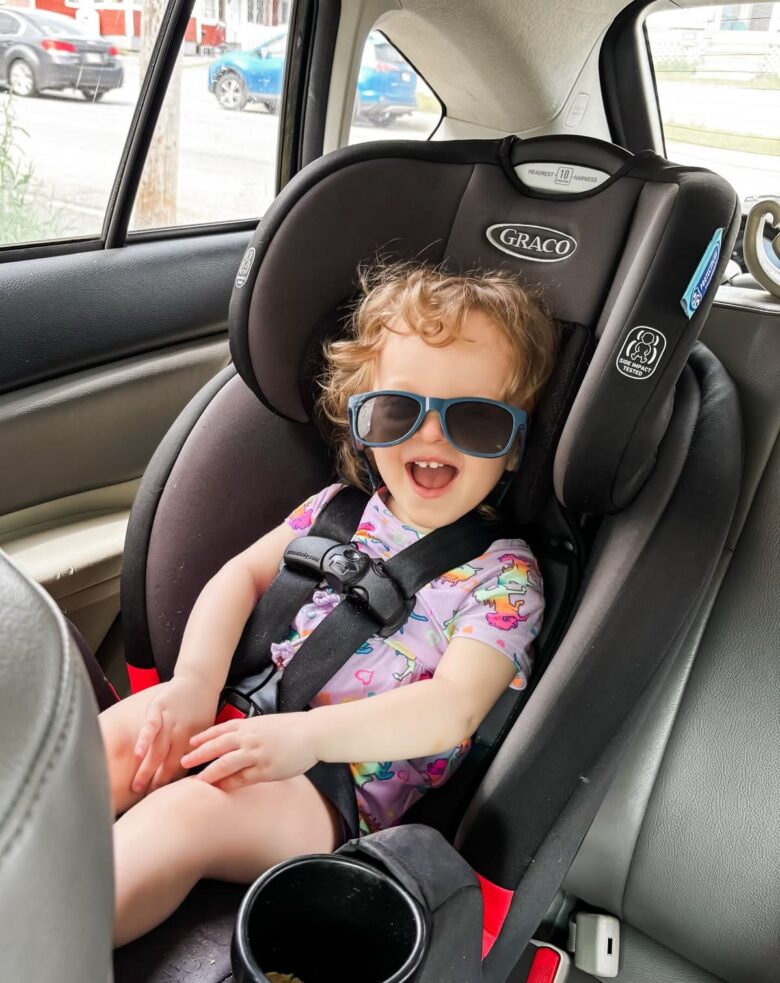
A child’s feet touching the vehicle seat back does not mean the rear-facing seat has been outgrown. HealthyChildren.org notes that children are flexible, can find comfortable positions, and very rarely suffer leg injuries while riding rear-facing.
Children may bend their knees, cross their legs, rest their feet against the vehicle seat back, or place their legs over the sides of the car seat. Leg position is not, by itself, a reason to turn a child forward-facing.
Do not add a footrest, padding, strap covers, mirrors, or other aftermarket accessories unless the car-seat manufacturer allows the product for use with that specific seat. NHTSA does not recommend aftermarket products unless they are made or permitted by the original car-seat manufacturer.
When Forward-Facing Becomes Appropriate
A child is ready to move from rear-facing to forward-facing when the child reaches a rear-facing limit or no longer satisfies another rear-facing requirement specified by the manufacturer. Depending on the seat, those requirements may include:
- The maximum rear-facing weight
- The maximum standing height
- A required amount of space between the child’s head and the top of the seat shell or headrest
- A required headrest, harness, recline, or seat-setting position
- Any model-specific age, fit, or use requirement stated in the manual
Do not assume that every seat uses a universal “1-inch rule” for head clearance. Head-clearance and height requirements differ among products. Follow the instructions for the exact model and mode being used.
After rear-facing is outgrown, the next step is generally a forward-facing seat with a harness and top tether. Depending on the product, that may be the same convertible or all-in-one seat changed to forward-facing mode, or a separate combination seat that later converts to a booster.
Many children with special health care needs can use a conventional car seat, but some require individualized positioning or specialized restraints. Work with the child’s health care team and a child passenger safety technician with additional special-needs transportation training rather than modifying a seat or changing its orientation without qualified guidance.
What the Research Does—and Does Not—Show
You may still encounter claims that rear-facing is universally “five times safer.” That specific figure should not be presented as a current universal estimate. It came from a 2007 study that was later retracted after concerns about how the data were analyzed. The AAP acknowledged the retraction when it issued its 2018 guidance.
The retraction did not reverse the recommendation to keep children rear-facing to the seat’s limits. The AAP based its guidance on the overall body of evidence, including child anatomy, crash biomechanics, laboratory testing, international experience, and available real-world crash data.
A newer peer-reviewed study published in 2023 examined Kansas crash records from 2011 through 2020 for children ages 0 through 4. After adjustment for potential confounding factors, rear-facing use was associated with 9% lower odds of any reported injury compared with forward-facing use. Estimates involving incapacitating or fatal injuries were imprecise because those outcomes were uncommon in the data.
That observational study cannot prove what would happen in an individual crash or establish one universal percentage for every child, seat, and vehicle. It is newer research, but it did not create a new 2026 AAP policy. The long-standing practical recommendation remains the same: delay the transition until the child has genuinely outgrown rear-facing.
State Law and Safety Guidance Are Not the Same
Child-passenger-safety laws vary substantially by state. A state law may permit a child to face forward before current best-practice guidance recommends the transition.
Law establishes the legal minimum a driver must follow. Safety guidance describes practices recommended by organizations such as NHTSA and the AAP. A legal minimum is not necessarily the safest available choice for a child who still fits properly in an appropriate rear-facing seat.
Check current law through an official state government or legislature website. Also follow the car-seat manufacturer’s instructions, which may be more restrictive than state law.
See our related guide to Child Passenger Safety Laws Most Parents Don’t Fully Understand. Verify any state-specific information before relying on it for a trip or seating decision.
How to Tell Whether a Rear-Facing Seat Still Fits
Check Every Manufacturer Limit
- Find the rear-facing section of the car-seat manual.
- Check the child’s current weight and standing height.
- Check the required head clearance and headrest position.
- Confirm that the harness, recline, and other seat settings are approved for rear-facing use.
- Check the labels on the seat, but use the manual for complete model-specific instructions.
Check the Harness
- For rear-facing use, route the harness at or below the child’s shoulders as directed by the manual.
- Make sure the straps lie flat without twists.
- Tighten the harness until you cannot pinch excess webbing at the child’s shoulder.
- Place the chest clip at armpit level.
- Do not place bulky coats, snowsuits, or thick blankets under the harness. Buckle the child first and place a coat or blanket over the secured harness if needed.
Check the Installation
- Use the rear-facing belt path.
- Check movement at the belt path. The installed seat should not move more than 1 inch from side to side or front to back at that point.
- Use the seat’s recline indicator and an angle permitted for the child’s size and the seat’s rear-facing mode.
- Use an installation method allowed by both manuals. Car seats are ordinarily installed with either the vehicle seat belt or lower anchors, not both, unless the car-seat and vehicle manufacturers expressly permit combined use.
For more installation guidance, see How to Know if Your Car Seat Is Installed Correctly Without Paying a Technician. If fit or installation remains uncertain, use NHTSA’s inspection resources to find in-person or virtual assistance.
Installation Considerations for Rear-Facing Seats
Common problems include:
- Incorrect recline: Use the seat’s built-in indicator and instructions. Do not assume that one angle is correct for every seat or every child.
- Loose installation: Check for no more than 1 inch of movement at the belt path.
- Wrong belt path: Convertible and all-in-one seats generally use different belt paths or settings for rear-facing and forward-facing modes.
- Loose or twisted harness straps: The straps should lie flat and fit snugly.
- Unapproved accessories: Use only inserts, padding, strap covers, seat protectors, or other products allowed by the car-seat manufacturer.
- Incorrect contact with the front seat: Rules about contact between a rear-facing car seat and the vehicle seat in front vary. Check both manuals rather than intentionally bracing the car seat or creating an arbitrary gap.
The seating arrangement must also allow the driver to sit in a safe position and operate the vehicle properly. If one rear-facing seat is incompatible with the vehicle, consider another seat that fits the child and vehicle correctly. Do not turn the child forward-facing solely because a particular car-seat model does not fit.
Car seats are intended for transportation. If a baby falls asleep during a drive, keep the baby properly harnessed while the vehicle is moving. At the destination, transfer the baby to an appropriate firm, flat sleep surface rather than using the car seat for routine sleep outside the vehicle.
The Bottom Line: What to Check Now
- Read the manual: Confirm all rear-facing weight, height, head-clearance, harness, recline, and installation requirements.
- Check the child’s current fit: Do not estimate based only on age, clothing size, or leg position.
- Check the installation: Use the correct belt path and recline setting, and check for no more than 1 inch of movement at the belt path.
- Check the harness: Position the straps at or below the shoulders, place the chest clip at armpit level, and remove pinchable slack.
- Register the seat and check recalls: Registration allows the manufacturer to contact you if the seat has a safety recall. NHTSA also provides a car-seat recall search.
If the child still satisfies every rear-facing requirement, current AAP and NHTSA guidance recommends keeping the child rear-facing. When rear-facing is genuinely outgrown, move to a correctly used forward-facing seat with a harness and top tether.
For the later transition from a harness to a booster, see The Most Common Booster Seat Mistakes That Put Kids at Risk.
Frequently Asked Questions
Q: My child is 18 months old and 30 pounds. The seat rear-faces to 40 pounds. Should I turn the seat around?
A: Not based on those facts alone. Continue rear-facing if the child remains within every applicable weight, height, head-clearance, age, and fit requirement in the manual. Weight is only one part of the fit check.
Q: My child’s legs are bent against the vehicle seat back. Is that safe?
A: Bent or crossed legs do not mean the seat has been outgrown. Leg position alone is not a reason to turn a child forward-facing. Check the manufacturer’s weight, height, head-clearance, and other fit limits.
Q: Can I install a rear-facing seat in the front passenger seat?
A: Never place a rear-facing seat in front of an active frontal air bag. Children younger than 13 should ride in the back seat for optimal protection. If a vehicle has no usable back seat, consult the vehicle and car-seat manuals. The passenger air bag must be disabled through a system approved for that vehicle or, where applicable, an NHTSA-authorized on-off switch before a rear-facing child rides there.
Q: My rear-facing seat is too large for my small car. What should I do?
A: Check both manuals for permitted recline positions and front-seat contact rules. If the seat prevents a safe driving position or cannot be installed correctly, consider a different car seat that fits the child and vehicle or get help from a child passenger safety technician. A seat must fit the child, fit the vehicle, and be used correctly.
Q: Is there an age when rear-facing automatically becomes unsafe?
A: There is no universal birthday when rear-facing automatically becomes unsafe. Follow every limit and rule for the seat’s rear-facing mode, including any model-specific age requirement. Never continue rear-facing after the child has exceeded a manufacturer limit.
Q: Is “rear-facing until age 2” still the recommendation?
A: Age 2 is not the current universal transition point. The AAP changed that wording in 2018. Keep the child rear-facing until the maximum rear-facing height or weight permitted by the specific seat manufacturer, while also following all other fit requirements.
Safety Disclaimer: This information is general educational guidance and is not medical or legal advice. Always follow the instructions for the specific car seat and vehicle, verify current state law through an official source, and consult the child’s health care team or an appropriately trained child passenger safety technician when medical or specialized transportation needs are involved. In an emergency, call 911.
Sources
- American Academy of Pediatrics: Child Passenger Safety policy statement, published in 2018 and reaffirmed in February 2025
- American Academy of Pediatrics: Child Passenger Safety technical report, reaffirmed in February 2025
- HealthyChildren.org: Car Seats—Information for Families
- NHTSA: Car Seats and Booster Seats
- NHTSA: How to Install Rear-Facing Car Seats
- NHTSA: Car Seat Glossary and Aftermarket Product Guidance
- NHTSA: Vehicle Air Bags and Injury Prevention
- NHTSA: Vehicle and Car-Seat Recall Lookup
- PubMed: Rear-facing child safety seat effectiveness—evidence from motor vehicle crash data
- American Academy of Pediatrics: Transporting Children With Special Health Care Needs, reaffirmed with updates in July 2025
- HealthyChildren.org: Safe Sleep and Transferring a Baby From a Car Seat After Travel
Kids Aren’t Cars Editorial Team researches and maintains practical educational content about child passenger and vehicle safety. Our articles prioritize current official guidance, manufacturer instructions, primary sources, and clear corrections when information changes. Professional review is identified on an individual article only when a specific qualified reviewer has actually participated and can be identified.