Last Updated: August 11, 2026
Editor’s Note: This guide covers child passenger safety, comfort, breaks, meals, temperature control and driver alertness during extended vehicle travel. For motion sickness help, see How to Prevent Motion Sickness in Kids During Long Drives. For emergency supplies, see Essential Family Car Emergency Kit Most Parents Forget to Prepare.
Plan for a Safer, Less Stressful Trip
Long road trips can disrupt meals, naps, bathroom routines and normal opportunities for movement. They can also increase driver fatigue and distraction. A safer plan allows extra time for stops while keeping every occupant properly restrained whenever the vehicle is moving.
The American Academy of Pediatrics advises families to plan a break about every two hours during long drives. Treat that as a general planning guideline, not a reason to keep going when someone needs an earlier stop. Pull over sooner for feeding, diapering, bathroom needs, overheating, vomiting, significant distress or driver fatigue.
Break needs vary from one trip to another. A baby may need an earlier feeding or diaper change, while an older child may need the bathroom or a chance to move. Drivers should stop as soon as drowsiness develops rather than waiting for the next planned break.
Pre-Trip Safety Checks
Check the Car Seat or Booster
- Read both manuals: Follow the car seat manufacturer’s instructions and the vehicle owner’s manual. Installation methods, recline settings, seating positions and permitted accessories vary.
- Confirm the correct mode: Check the child’s current height and weight against the manufacturer’s limits for rear-facing, forward-facing or booster use.
- Test the installation: A harnessed car seat should not move more than 1 inch from side to side or front to back when tested at the belt path. Do not test by pulling on the top of the seat.
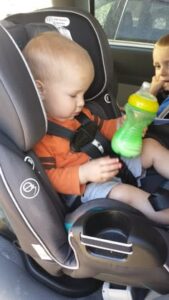
- Check harness fit: The straps should lie flat without twists and be snug enough that you cannot pinch extra material at the child’s shoulder. Position the chest clip at armpit level.
- Check the recline: Install a rear-facing seat at the angle specified by its manufacturer, using the seat’s indicator or adjuster when provided.
- Remove bulky clothing: Puffy coats and other bulky layers can interfere with a snug harness. Buckle the child in thin layers, then place a coat or blanket over the secured harness if needed.
- Register the seat: Registration allows the manufacturer to contact you about recalls and safety notices.
- Check for recalls: Search for vehicle, tire, car seat and equipment recalls on NHTSA’s recall page.
For more help, see How to Know if Your Car Seat Is Installed Correctly Without Paying a Technician. NHTSA also provides a locator for in-person and virtual car seat assistance.
Review Any Crash or Used-Seat History
NHTSA recommends replacing a car seat after a moderate or severe crash. A seat does not automatically need replacement after a minor crash, but all of NHTSA’s minor-crash criteria must be satisfied. Always follow the car seat manufacturer’s instructions, which may require replacement under different circumstances.
Before using a borrowed, secondhand or rental car seat, confirm that:
- Its moderate-to-severe crash history is known.
- Its date-of-manufacture and model-number labels are present.
- It is not too old under the manufacturer’s instructions.
- It has no unresolved recall.
- All required parts are present and undamaged.
- The instructions are available.
Prepare the Vehicle
- Inspect the tires: Check pressure while the tires are cold. Use the recommended pressure on the vehicle’s door placard or in the owner’s manual, not the pressure molded into the tire. Inspect the tread and sidewalls, and check the spare if the vehicle has one.
- Address warning signs: Have leaks, damaged tires, braking concerns, cooling problems or warning lights evaluated before departure.
- Check fluids and visibility: Follow the owner’s manual for oil, coolant, brake fluid and other applicable maintenance. Confirm that lights, wipers and windshield washers work.
- Test the air conditioning or heat: Make sure the rear seating area can remain comfortable. If the cabin becomes dangerously hot or the air conditioning fails in hot weather, stop in a safe, cool location.
- Check rear-door child locks: Make sure child locks and window controls are set appropriately before leaving.
Plan the Route and Stops
- Build breaks into the schedule: Identify safe rest areas, parks, restaurants or other stopping places along the route.
- Allow extra time: Feeding, bathroom, diaper and movement stops are part of traveling with children, not unexpected delays.
- Check conditions: Review weather, traffic and road conditions before leaving, and keep an alternate route available.
- Set up navigation before moving: The driver should not program a device, search through bags or reach into the back seat while driving.
- Plan lodging when necessary: Do not make overnight driving a substitute for adequate driver sleep.
Secure the Load
Place luggage and heavy equipment in the trunk or designated cargo area when possible. Secure the load so it cannot shift or leave the vehicle during sudden braking, a sharp turn or a crash.
- Keep hard or heavy objects away from children.
- Choose soft, lightweight toys for the passenger area.
- Secure coolers, emergency kits, strollers and other large items.
- Do not overload roof racks, cargo carriers or trailers.
- Check external cargo again after the first stop and whenever straps or covers have been disturbed.
For help organizing roadside supplies, see our essential family car emergency kit guide.
Restraint Safety Does Not Change on a Long Drive
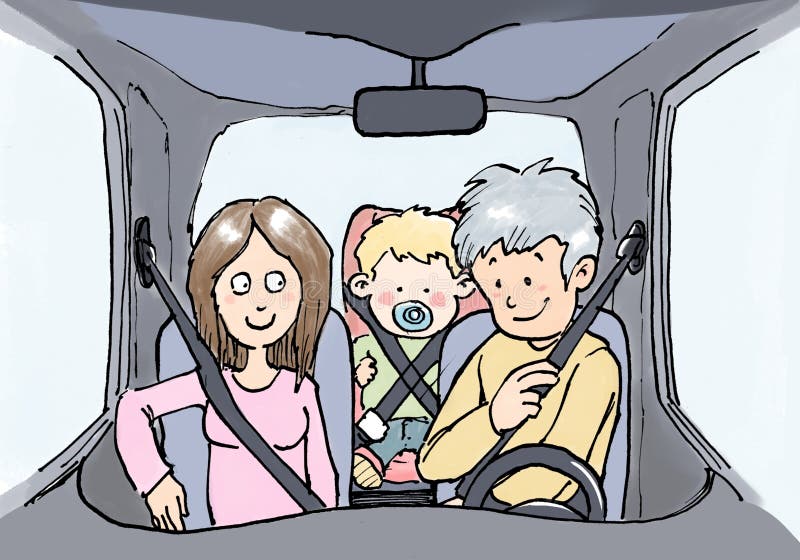
- Everyone remains properly restrained whenever the vehicle is moving. If a child needs to get out, pull over and park in a safe place first.
- Keep children rear-facing as long as possible. Continue until the child reaches the highest rear-facing height or weight allowed by the car seat manufacturer.
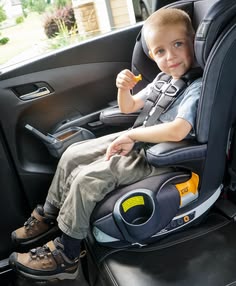
- Use a forward-facing harness and tether next. Keep the child harnessed until the forward-facing limits of the seat are reached, and use the top tether as directed by the car seat and vehicle manuals.
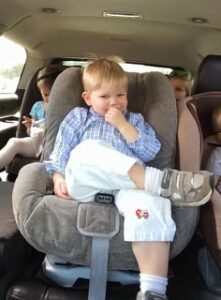
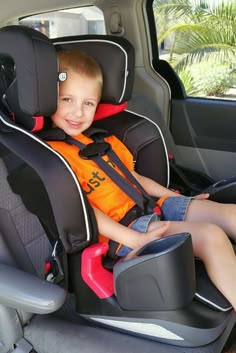
- Use a booster until the seat belt fits properly. The lap belt should lie low across the hips or upper thighs, not the stomach. The shoulder belt should cross the chest and shoulder rather than the neck or face.
- Keep children under 13 in the back seat. Never place a rear-facing car seat in front of an active passenger air bag.
- Do not move a child to the next restraint early for convenience. A long drive does not change the manufacturer’s height or weight limits.
- Follow applicable law: Child restraint laws vary by state. Safety recommendations may provide protection beyond a state’s legal minimum.
For more information about choosing a seating position, see our car seat position guide.
When a Child Wants Out
Never loosen or unbuckle a child’s restraint while the vehicle is moving. Instead:
- Use the next safe exit, rest area or parking area.
- Check for hunger, thirst, a wet diaper, overheating, motion sickness, pain or twisted straps.
- Make sure clothing or an object is not pressing uncomfortably against the child.
- Confirm that the harness or seat belt remains correctly positioned.
- Offer music, conversation, a soft toy or a visual game after the child is properly buckled again.
If the child’s distress is distracting the driver, stop safely even if a scheduled break is not yet due.
Keeping Children Comfortable
Clothing and Temperature
- Dress children in comfortable, thin layers that do not interfere with the harness or seat belt.
- Check the temperature in the rear seating area instead of assuming it matches the front.
- For a baby, feel the chest or back for signs of overheating rather than relying only on hands or feet.
- Use climate controls and built-in shades when available. Any added shade must be securely installed and must not interfere with airbags, windows or visibility.
- Never leave a child alone in a parked vehicle, even briefly or with the windows open or air conditioning running.
If the vehicle cannot maintain a safe cabin temperature, stop at a safe indoor or shaded location and address the problem before continuing.
Infant Positioning
A rear-facing seat must be installed at the recline angle specified by its manufacturer. A baby’s back and bottom should be against the seat, with the harness correctly positioned and snug.
If a baby’s head repeatedly falls forward into a chin-to-chest position, pull over. Check the recline angle, harness fit and the car seat instructions. Do not add an aftermarket head support, insert, pillow or padding unless the car seat manufacturer permits that specific product.
Activities
- Choose soft, lightweight toys and books rather than hard or heavy objects.
- Use music, audiobooks, storytelling, sing-alongs and verbal games to reduce the number of loose items in the vehicle.
- Encourage children who become carsick to look outside rather than down at a book, game or screen.
- Keep necessary items within reach of a properly restrained adult passenger, not the driver.
- Do not allow activities to interfere with harnesses, seat belts, airbags or the driver’s view.
Make Breaks Useful
For most family trips, begin by planning a stop about every two hours. Stop earlier whenever a passenger or driver needs care, movement or rest.
Breaks With Babies
- Plan around the baby’s usual feeding and diaper routines.
- Take the baby out of the car seat at stops.
- Provide supervised floor movement or tummy time on a clean, safe surface when appropriate.
- Check the baby’s temperature, skin and clothing.
- Feed only after the vehicle is safely parked.
- Recheck the harness before getting back on the road.
Breaks With Toddlers and Older Children
- Use the bathroom and wash hands.
- Walk, stretch or play in a safe area away from moving vehicles.
- Offer food and drinks while the child is seated and supervised.
- Check clothing and remove bulky layers before buckling again.
- Confirm that the harness or seat belt fits correctly before departure.
Breaks for Drivers
- Walk and assess whether you are still fully alert.
- Switch drivers before the current driver becomes dangerously sleepy.
- Revise the arrival time if weather, traffic, illness or fatigue changes the plan.
- Arrange lodging if no driver is alert enough to continue safely.
Meals, Feeding and Hydration
Feed Children While Safely Stopped
The CDC advises against allowing young children to eat in a car because choking can be difficult to recognize and manage promptly. Plan meals and snacks for safe stops where the child can sit upright and be closely supervised.
- Prepare food in the correct shape, size and texture for the child’s development.
- Avoid small, hard, sticky or round foods that are difficult for a young child to chew and swallow.
- Keep meals calm and free from rushing or unnecessary distractions.
- Never breastfeed while the vehicle is moving.
- Stop and park before bottle-feeding so the baby and caregiver can be positioned safely and the feeding can be monitored.
Offer Appropriate Fluids
- Bring water for older infants and children, along with the child’s usual milk when appropriate.
- Infants younger than about 6 months should receive breast milk or correctly prepared infant formula rather than extra water unless their pediatrician advises otherwise.
- Continue normal breast milk or formula feeding during the trip.
- Offer drinks at stops instead of relying on a bottle or cup left unattended with a young child.
- Watch for dry mouth, fewer wet diapers or less urination, unusual sleepiness, irritability or other signs of dehydration.
Call the child’s pediatrician promptly if you are concerned about dehydration or the child cannot keep fluids down. Call 911 for severe symptoms, unresponsiveness or another medical emergency.
Driver Fatigue and Distraction
NHTSA identifies midnight to 6 a.m. and the late afternoon as periods when drowsy-driving crashes occur most frequently. Adequate sleep is the primary way to protect against drowsy driving.
- Begin well-rested: Do not start a long drive already short on sleep.
- Watch for warning signs: Trouble focusing, crossing lane markings, hitting a rumble strip or missing an exit means it is time to stop.
- Do not try to push through: Open windows, loud music and conversation are not substitutes for sleep.
- Use short-term measures cautiously: Caffeine and a short nap may temporarily increase alertness, but they do not correct serious sleep deprivation.
- Stop in a safe place: Use a designated rest area or another suitable location rather than stopping on the shoulder unless there is an emergency.
- End the driving day when necessary: An unplanned hotel stay is safer than continuing without an alert driver.
A distressed or vomiting child can also distract the driver. Do not turn around, reach into the rear seat or attempt to adjust a harness while moving. Pull over and park before providing hands-on help.
Rental Vehicles and Overnight Stops
Using a Car Seat in a Rental Vehicle
- Bring a familiar seat when practical: You will know its history, instructions and parts.
- Read the rental vehicle manual: Find the approved seating positions, seat-belt instructions and tether anchors.
- Inspect a rental-provided seat: Confirm that it is appropriate for the child’s age and size, appears undamaged and comes with instructions.
- Apply the used-seat checklist: Do not use a seat with an unknown moderate-to-severe crash history, missing labels, missing parts, an unresolved recall or no available instructions.
- Install it yourself: Do not assume that a rental employee’s installation is correct.
Safe Sleep After Arrival
A baby may sleep in a properly installed car seat while the vehicle is moving. After arrival, move the baby to a firm, flat sleep surface intended for infant sleep.
- Use a crib, bassinet, portable crib or play yard that is in good condition.
- Place the baby on their back.
- Use the product’s supplied mattress and a fitted sheet.
- Keep pillows, loose blankets, toys, bumpers, positioners and added padding out of the sleep space.
- Inspect hotel-provided equipment for missing or broken parts and request a replacement if its safety is uncertain.
Motion Sickness
For a child prone to car sickness, looking outside may be more comfortable than focusing on books, handheld games or screens. Music, conversation and verbal games can provide distraction without close visual focus.
A light snack before travel may help some children, but food should be given while safely stopped and supervised. Keep the cabin comfortably cool and stop if the child becomes pale, restless, sweaty, nauseated or begins vomiting.
Ask the child’s pediatrician before using motion-sickness medicine. Some products have age restrictions and can cause drowsiness or other side effects. See How to Prevent Motion Sickness in Kids During Long Drives for more guidance.
Frequently Asked Questions
Q: How often should a family stop on a long road trip?
A: The AAP recommends planning a break about every two hours. Stop sooner for feeding, diapering, bathroom needs, movement, illness, distress or driver fatigue.
Q: Can a baby sleep in a car seat during the drive?
A: A baby may sleep in a properly installed car seat while traveling in the vehicle. Check the baby’s position and temperature regularly. Once you arrive, move the baby to a firm, flat sleep surface intended for infant sleep.
Q: Can we drive through the night while the children sleep?
A: Do not use overnight driving as a substitute for driver sleep. NHTSA identifies midnight to 6 a.m. as a peak sleepiness period. Stop immediately if the driver has trouble focusing, drifts from the lane or shows other signs of drowsiness.
Q: Is it safe to breastfeed in a moving vehicle?
A: No. The baby would not be properly restrained, and the adult could not safely breastfeed while correctly positioned in a seat belt. Pull over and park before feeding, then properly restrain everyone before moving again.
Q: Can children eat snacks while the car is moving?
A: The CDC advises against letting young children eat in a car. Use planned stops so the child can sit upright and be closely supervised while eating developmentally appropriate food.
Q: What should I do if my child is crying or wants to get out?
A: Keep the child properly restrained and use the next safe place to pull over. Check for discomfort, hunger, overheating, motion sickness, a wet diaper or a harness problem after the vehicle is parked.
The Bottom Line
Successful road trips depend on a flexible schedule and consistent safety rules. Keep every occupant properly restrained whenever the vehicle is moving, plan breaks about every two hours, stop sooner when needed, secure the cargo, supervise all feeding at stops and end the driving day when the driver is tired.
Safety and Medical Disclaimer: This article provides general information and does not replace the car seat or vehicle manual, applicable state and local law, advice from a pediatrician, assistance from a qualified Child Passenger Safety Technician or emergency services. Call 911 in an emergency.
Sources
- https://www.healthychildren.org/English/safety-prevention/on-the-go/Pages/Travel-Safety-Tips.aspx
- https://www.healthychildren.org/English/tips-tools/ask-the-pediatrician/Pages/Is-it-safe-for-my-baby-to-travel-in-a-car-seat-a-few-hours-at-a-time.aspx
- https://www.nhtsa.gov/vehicle-safety/car-seats-and-booster-seats
- https://www.nhtsa.gov/car-seats-and-booster-seats/how-install-rear-facing-car-seats
- https://www.nhtsa.gov/vehicle-safety/air-bags
- https://www.nhtsa.gov/recalls
- https://www.nhtsa.gov/car-seats-and-booster-seats/car-seat-use-after-crash
- https://www.nhtsa.gov/car-seats-and-booster-seats/used-car-seat-safety-checklist
- https://www.nhtsa.gov/summer-driving-tips
- https://www.nhtsa.gov/drive-safe-secure-your-load
- https://www.nhtsa.gov/risky-driving/drowsy-driving
- https://www.cdc.gov/infant-toddler-nutrition/foods-and-drinks/choking-hazards.html
- https://www.healthychildren.org/English/healthy-living/nutrition/Pages/Choose-Water-for-Healthy-Hydration.aspx
- https://www.healthychildren.org/English/tips-tools/ask-the-pediatrician/Pages/What-is-the-safest-sleep-solution-for-my-baby-with-reflux.aspx
- https://www.healthychildren.org/English/safety-prevention/on-the-go/Pages/Winter-car-seat-safety-tips.aspx
- https://www.healthychildren.org/English/health-issues/conditions/head-neck-nervous-system/Pages/Car-Sickness.aspx
Kids Aren’t Cars Editorial Team researches and maintains practical educational content about child passenger and vehicle safety. Our articles prioritize current official guidance, manufacturer instructions, primary sources, and clear corrections when information changes. Professional review is identified on an individual article only when a specific qualified reviewer has actually participated and can be identified.